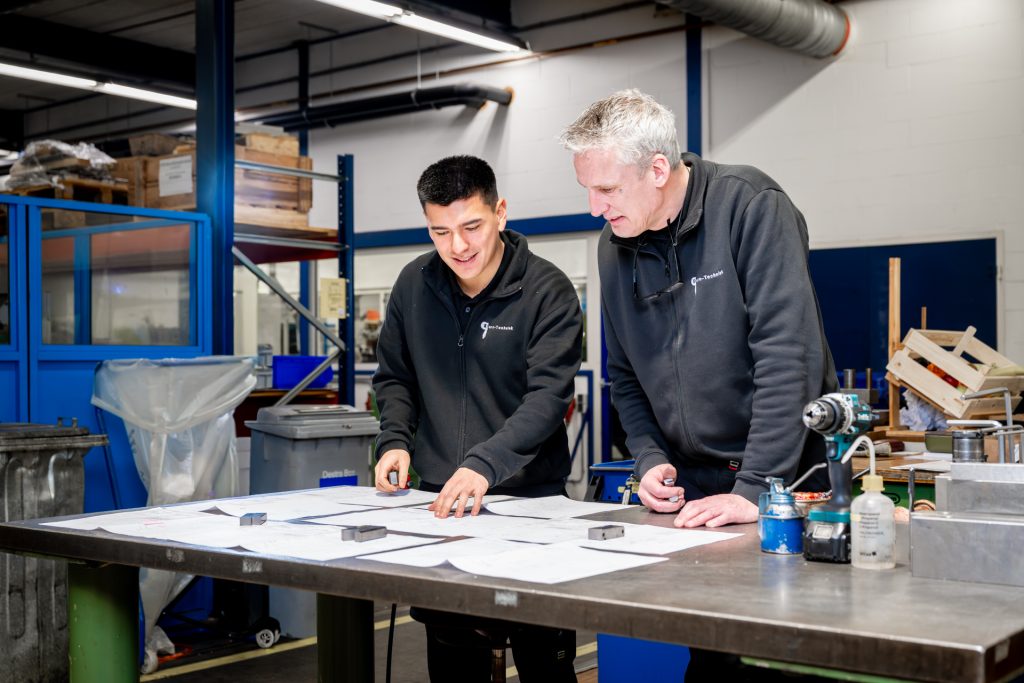
Have you ever considered the impact of a microscopic dust particle on a mechanism? In precision engineering products, even the slightest contamination can lead to jamming or wear. A controlled environment is therefore not a luxury, but a technical necessity. In this article, you will read how we guarantee absolute accuracy in a clean environment.
Why clean work is necessary
Modern technology is becoming increasingly smaller and more complex. Components often fit together seamlessly with minimal tolerances. A speck of dust between two gears or bearings immediately acts like a brake.
In our In a cleanroom, we eliminate these risk factors fully. The air is continuously filtered to remove airborne particles. This ensures that the mechanical properties of your product are maintained. It prevents malfunctions that are unavoidable in a normal workshop.
The human factor in the process
Machines can do a lot, but for precise assembly, humans are often indispensable. Assembling minuscule parts requires a steady hand and insight. Our employees are specially trained for this delicate work.
Discipline is the key word here. Every movement in the cleanroom must be calm and controlled. Quick movements stir up air and potentially dust. At Euro-Techniek, strict protocols ensure consistently high quality of work.
Micro-assembly tools
The naked eye is often insufficient for this precision work. We use optical aids and magnification equipment. This allows us to check directly whether a part has been correctly placed.
Additionally, we use specific tools that do not release particles. Think of stainless steel tweezers or special screwdrivers. Each tool is thoroughly cleaned before use. This way, we exclude any source of contamination during assembly.
Applications of clean assembly
Not every product requires a cleanroom, but for some sectors, it is crucial. These often involve products where failure is not an option. We are seeing increasing demand from various industries.
We regularly assemble the following products under conditioned circumstances:
- Optical instruments such as lenses and binoculars that must be spotless.
- Medical components that must remain extremely clean.
- Precision mechanical sensors that respond to the slightest deviations.
- Components that operate under precisely controlled conditions.
Quality control as a fixed component
Assembly is more than just joining parts together. Several checks take place during the process. We measure whether the assembly meets the specified requirements.
If there is a deviation, we can see it immediately under the microscope. We can then intervene before the product is sealed or glued. This interim validation saves you costs by preventing subsequent rejection.
Packing for transport
All that effort will have been for nothing if the product leaves the room dirty. The final step in the cleanroom is therefore packaging. Products are hermetically sealed or vacuum-packed in special film.
We sometimes use double packaging for extra protection. This ensures the product arrives with you just as clean as it was when manufactured by us. You can process it directly into your own operation without any additional cleaning.
Precise assembly in a cleanroom guarantees a perfectly functioning product. By excluding dust and contamination, your components perform optimally. You are choosing certainty, quality, and a longer lifespan for your technology. Would you like to know if your product would benefit from clean assembly? Explore the possibilities of our assembly department of get in touch Contact Euro-Techniek for advice.
Frequently asked questions about precision assembly in cleanroom assembly
No, certainly not. While electronics often require protection, it is also essential for mechanics and optics. Moving parts and lenses are at least as sensitive to dust as chips are.
We operate according to strict ISO standards for cleanrooms. Additionally, employees receive continuous training in discipline and technique. Regular air quality measurements ensure the conditions.
Yes, manual assembly in the cleanroom is highly flexible. It is precisely suited for prototypes or small to medium-sized batches. For these quantities, automation is often too expensive.